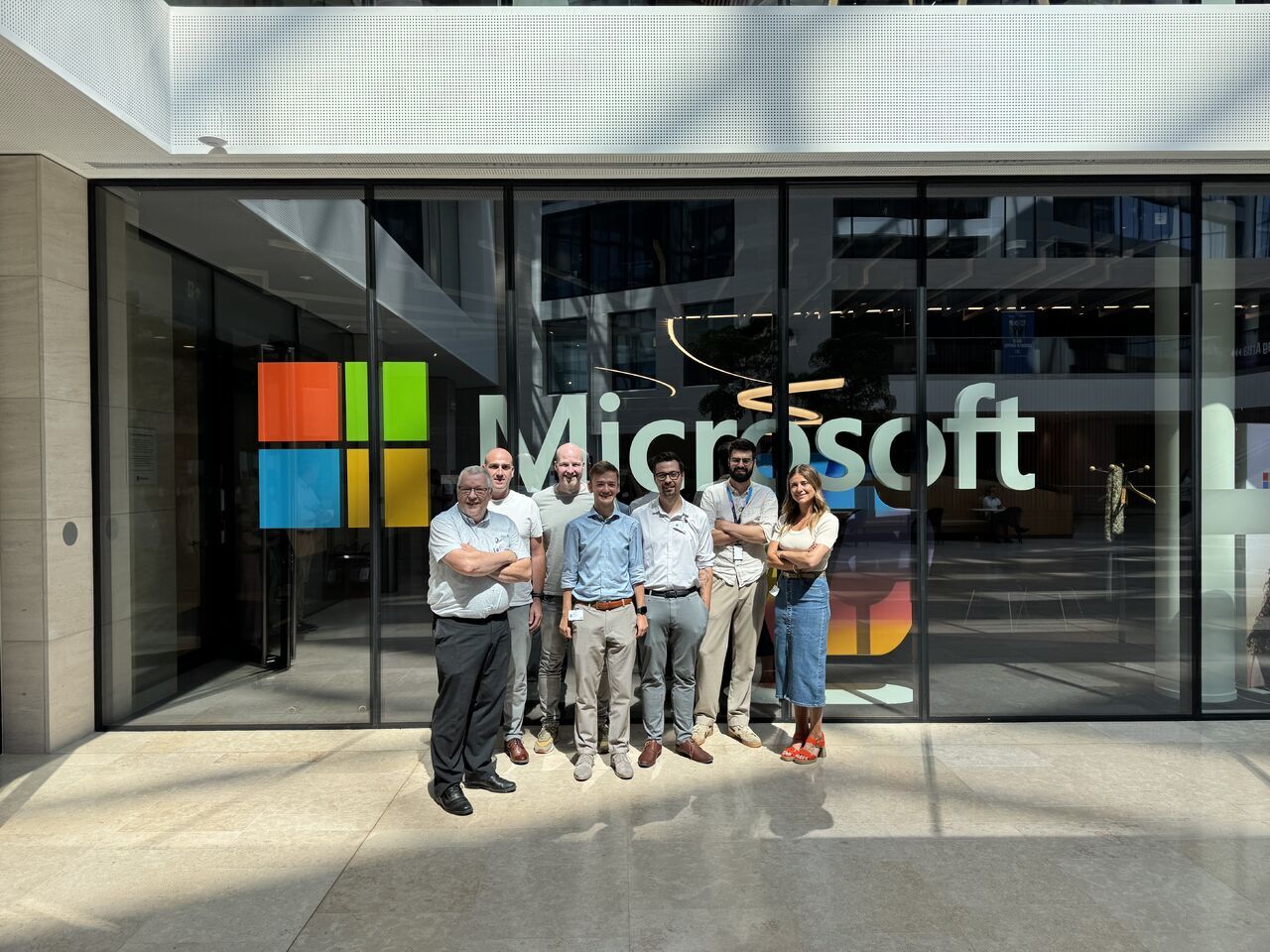
What if a process that takes 50 days could suddenly be completed in 12? That is what we worked on last week during the Microsoft Agentic AI Challenge.
Last week, Fluvius took part in the Microsoft Agentic AI Challenge together with our technical partner Cegeka. Two intensive hackathon days, one concrete challenge: how can we use AI agents to make a complex business process genuinely smarter?
Our use case: the "request to quote" process for grid connection requests involving high and very high power capacity. Today, the lead time for this process can, due to its complexity, extend to 50 days. The problem is not the people, but the system: repetitive search work, information spread across many sources and complex policy rules.
Back to basics for a moment: what exactly is an AI agent?
An AI agent is more than a chatbot that answers questions. It is AI that independently carries out a task: it plans steps, uses tools, consults systems and makes decisions, without needing to be guided through every step. Connect multiple agents and you get a network that can support an entire process from start to finish.
We built an MVP with four specialised agents working together:
🔹Orchestrator that manages the process
🔹Validator Agent that reads documents and extracts key values
🔹Intake Agent that combines information from multiple sources
🔹Report Agent that automatically generates study documents
The targeted impact: processing time from 9 hours to ~2 hours, lead time from 50 to ~12 days, a potential reduction of 75%!
Did we win the top prize? Unfortunately not, but we are taking away something at least as valuable: "lessons learned" and a concrete starting point to build on.
The three lessons I am taking away:
✅ Agentic AI only works well when the process is clear: inputs, exceptions, decision points, responsibilities and outputs need to be explicit.
✅ Build trust by introducing control points. Especially where interpretation, risk or customer impact is involved, it must be clear where AI advises and where a human decides.
✅ Do not think in terms of one agent that can do everything, but in focused agents with a clearly defined task. The strength lies in collaboration, not full autonomy.
Thank you to Microsoft for the excellent organisation and support (Hannes Laureys and Sebastiano Federighi), to Cegeka for the strong technical collaboration (Daisy Romih, Kenneth Nicasens and Jasper Callens), and to the Fluvius team for the valuable input (Bart De Valck, Kwinten Plaskie, Wim Dert and Bram Desmet).