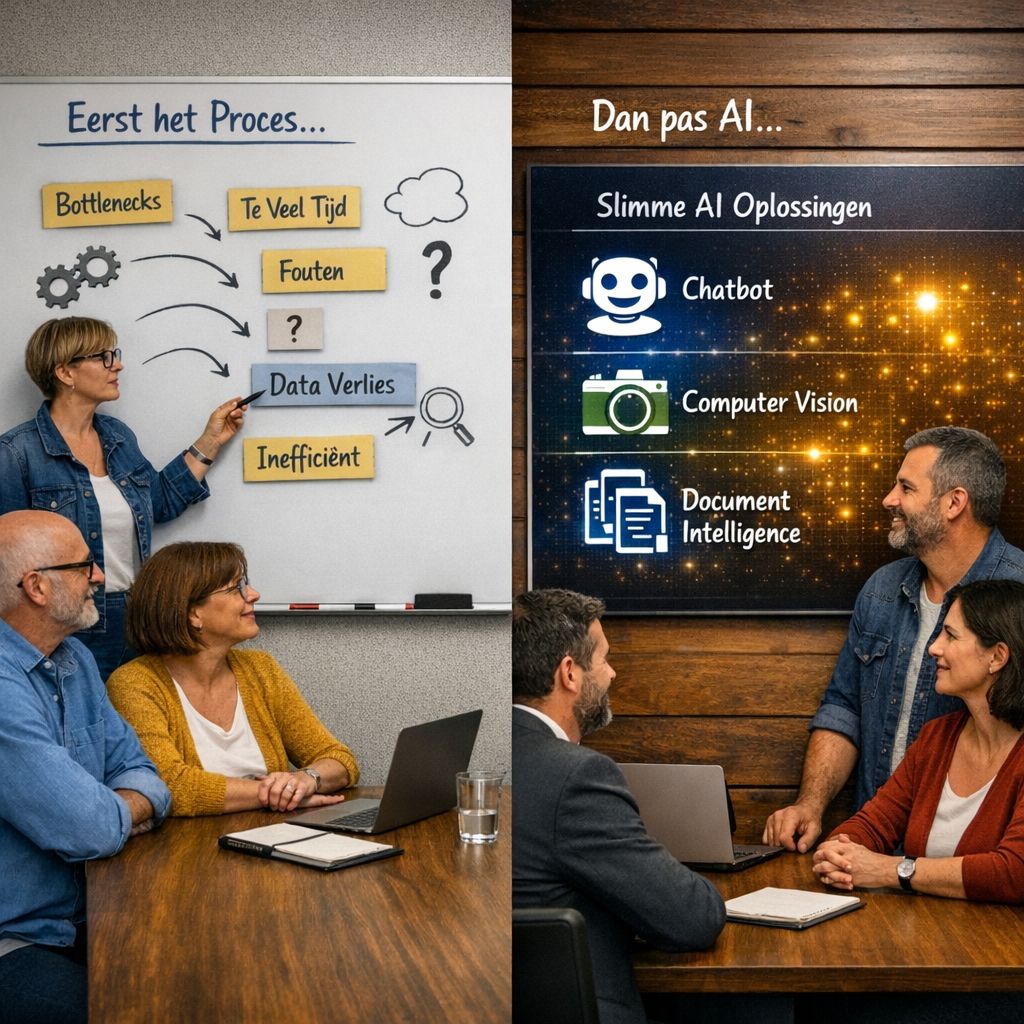
Want to do something with AI? Don't start with AI.
The biggest gains do not come from the model, but from the process where things are getting stuck or running inefficiently.
In practice, we still see the same pattern too often: a POC, a workshop or a hackathon built around the question: "what is the ideal AI use case here?". Or the classic: "we need a chatbot". These are not bad initiatives in themselves. They help generate ideas and explore possible directions, but as a starting point they are often too shallow.
Why? Because not everyone around the table can accurately assess what is technically, organisationally or economically feasible with AI today.
And because the key question often has not yet been asked: how does this process actually work today? Where does it lose time? Where are significant (excessive) costs incurred? Where does information get lost? Where are decisions made based on incomplete data? And where is work being done that does not actually add value?
This is not an insight that applies exclusively to AI. Good process improvement does not start with a solution, but with the process itself. Yet in AI initiatives, the opposite often happens: as soon as the ambition is framed as "we are going to invest in AI", people start thinking in terms of AI solutions. Inspiring use cases are then too quickly projected onto processes with different logic, different exceptions and different constraints.
And who do you need for this? Not only managers, architects or analysts, but also the people who execute these processes every day and encounter the friction first-hand. And these are often not the same people:
* Those who know the process may have normalised the friction for so long that they no longer notice it.
* Those who feel the pain can usually describe the symptoms perfectly, but do not always see the broader picture or the underlying cause.
By bringing those perspectives together, you not only get a clearer picture of the process. You also build support earlier among the people who will feel the impact of the change most directly. Only then does it become clear where AI can genuinely solve something.
And then - only then - does the technology choice become interesting. The solution can take many forms: document intelligence, computer vision, forecasting, agentic AI, or a combination of these. But which technology is most suitable should follow from the analysis of the process, not the other way around. AI gives us the opportunity to rethink entire processes.
Organisations that succeed at this ask the question differently:
Not: "What can AI do for us?"
But: "Where is our process structurally losing value today, and what changes if that friction disappears?"
That, to me, is the difference between picking up crumbs and achieving real scale.