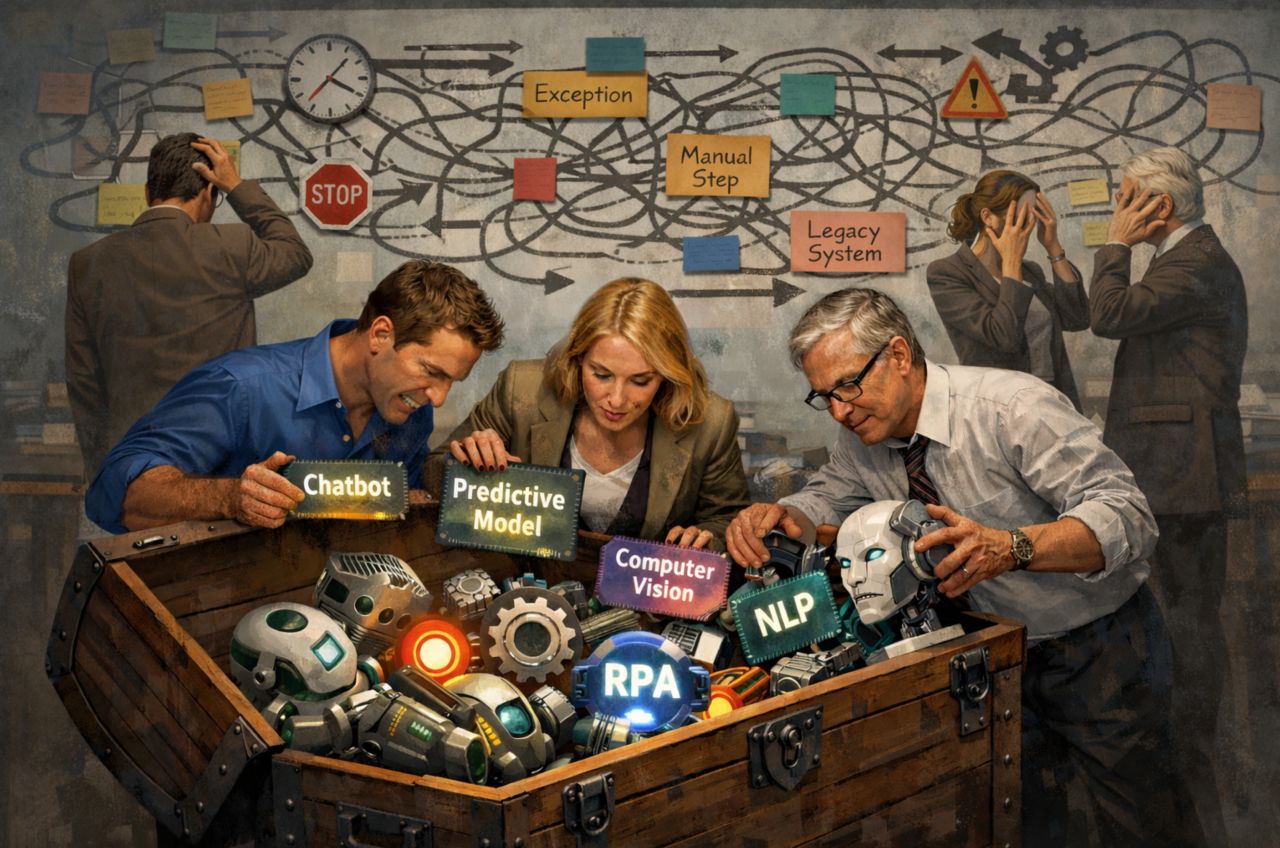
These are our lessons from practice.
Now that I've noticed that a Corporate IT Award for Fluvius not only looks good on a stage, but also makes my LinkedIn profile explode, I do want to reflect on what I am taking away from this journey in terms of substance, because an award is nice, but the lessons are more useful:
1️⃣ Start with the process, not the model
The cases that truly take hold start with a concrete pain point. But in a large organisation, "the process" is rarely neatly documented. There is legacy, there are exceptions, and the knowledge is spread across people who each know a different piece of the puzzle. Clarifying that determines whether you build something that fits reality, or something that is technically correct but operationally misses the mark.
2️⃣ Domain experts and AI experts need each other
A domain expert knows where the friction is, but not what AI can do about it. An AI expert knows what is technically possible, but not where it hurts operationally. So do not just ask: "What can AI do for you?", but especially ask where time is lost, what often goes wrong and what is still done manually. That is where the best use cases emerge.
3️⃣ A strong model is not yet a working solution
In isolation, AI logic can work extremely well. But then the real work begins: integration into systems, processes and data sources that were rarely built for AI. Legacy, limited APIs and mediocre data quality already make that complex enough. And then there is the human side: without trust, clear expectations and guidance on how people should work with it, even the best solution remains underused.
4️⃣ Data quality remains the silent bottleneck
You cannot build reliable AI on incomplete or inconsistent data, and you usually only discover that during implementation. Data varies in quality, is poorly documented or difficult to collect. Consistently underestimated.
5️⃣ You do not win trust with a flashy demo
You only win when people notice that the output is correct, consistent and remains useful in their daily reality. One mistake at a sensitive moment sticks longer than ten good results. Reliability builds more support than speed.
6️⃣ Going live is not the end
Adoption, change and communication already demand a lot of attention. But it does not stop there either: models degrade, processes change and data sources evolve. The question "who will manage this a year from now?" should be asked from the start.
👆 No theory, just practical knowledge gained through trial and error, and one award. What do you see go wrong most often?